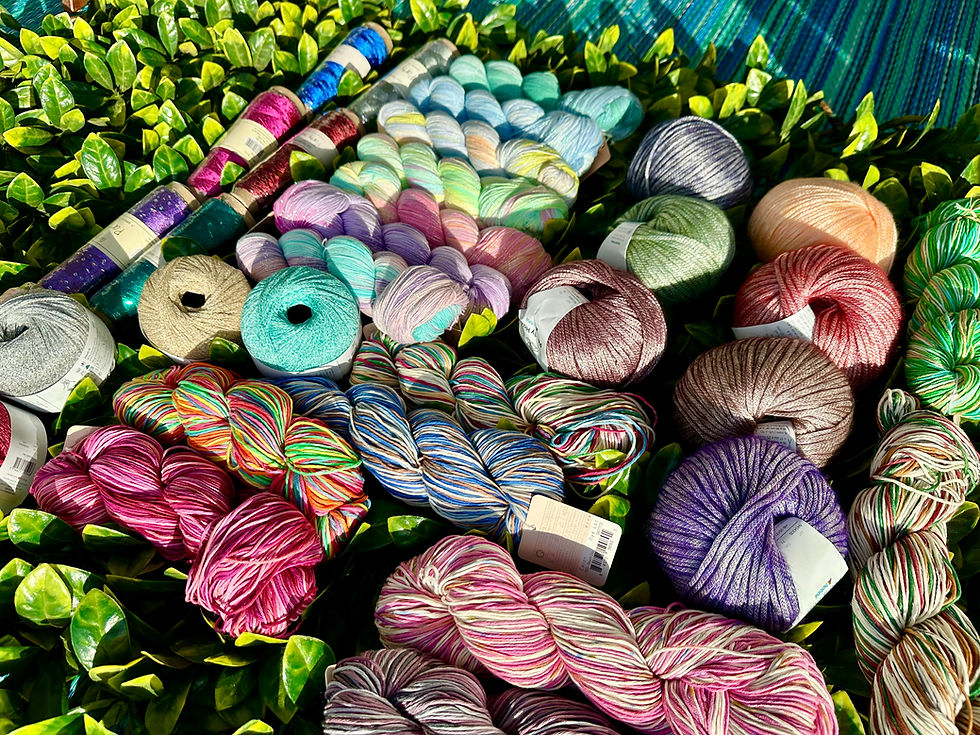
Why Does Some Yarn Come in Skeins?


If you've bought hand-dyed or speciality yarn, you may have opened the parcel expecting a neat, ready-to-use ball and found something quite different: a beautiful twisted bundle that clearly isn't ready to knit or crochet from straight away. If your first thought was "lovely, but what do I do with this?", you're in very good company. It's one of the most common questions we hear from makers who are new to skeins.
The short answer is that the skein isn't an inconvenience or an oversight. It's a deliberate, practical part of how quality yarn is produced, dyed and sold. Once you understand why yarn comes in skeins, the format makes a lot of sense and turning one into a usable ball is far easier than it looks.
Let's walk through it.
First, a Quick Note on Terminology
Yarn words are used a little differently depending on where you are in the world and even between yarn businesses, so it's worth clearing this up before we go further. We've covered this in depth in our guide to yarn configuration, but here's the short version!
A hank is a large, loose loop of yarn. Picture a big circle of strands, twisted back on itself only lightly, if at all. This is the form yarn is usually in while it's being dyed.
A skein is that hank twisted into a neat, compact bundle for display and transport. This is what you most often see on the shelf of a yarn shop or arriving in your parcel. In the United States, confusingly, "skein" usually refers to what we'd call a bullet skein, the oblong, ready-to-use shape you get with many commercial yarns. So if you're following an American pattern or video, keep that difference in mind.
A ball is a round bundle wound in a crisscross pattern, and a cake is a flat-topped cylinder wound with a machine, which you can usually work from the centre. Both a ball and a cake are ready to use.
So when we talk about a skein here, we mean the twisted bundle that needs to be wound before you use it, and the hank is the loop hiding inside it once you untwist it.
Why Sell Yarn in Skeins Rather Than Ready-Made Balls?
If a ball or cake is ready to use and a skein isn't, why do so many yarn producers, particularly indie dyers, sell their yarn in skeins? There are several good reasons, and most of them come back to protecting the quality of the yarn itself.
Hanks Are the Best Format for Dyeing
This is the big one. Hand-dyed, variegated and small-batch yarns are almost always dyed in hank form, and for good reason.
When yarn is in an open loop, dye can move freely and evenly around every strand. The dyer can lower the whole hank into a dye bath, hand-paint sections of it, or speckle it, and the colour reaches all of the yarn rather than just the outside. If you tried to dye a tightly wound ball, the outer layers would soak up colour while the centre stayed pale and patchy. The open hank is what makes even, considered, beautiful colourwork possible.
Once the dyeing is done and the yarn is dry, that hank is twisted into a skein so it can be handled and sold without tangling. The skein is essentially the hank in its travel-safe form.

Skeins Let You See What You're Buying
A twisted skein can be untwisted and opened out into its full loop in seconds (provided you get permission from the shop owner), which makes it wonderful for inspecting yarn before you commit to a project. You can see the full colourway laid out, get a proper sense of how a variegated or speckled yarn will shift and pool and check the overall dye job across the whole length rather than just the bit facing outwards.
It also makes it easier to spot any knots or joins in the yarn. With a ready-wound ball, much of the yarn is hidden from view. A skein shows you far more of what you're getting.
Skeins Keep the Yarn in Good Condition
Yarn wound into a ball or cake is under a little tension, and if it sits that way for a long time, that tension can gradually pull the stretch and bounce out of the fibre. This matters most for wool and other springy natural fibres, where elasticity is part of what makes the yarn lovely to work with.
Storing yarn as a skein keeps it in a relaxed, untensioned state, so the fibre holds onto its natural life until you're ready to use it. This is a large part of why so many natural-fibre and luxury yarns are traditionally sold this way.
Skeins Are Practical for the Dyer and the Shop
There's a practical side too. Skeins are tidy to store, easy to stack and transport, and they present beautifully, which matters when you're a small dyer or retail shop selling at markets or online. A shelf of twisted skeins in different colourways is beautiful to look at, and that presentation is part of the appeal of speciality yarn.
Can You Knit or Crochet Straight from a Skein?
Technically, sometimes. In practice, please don't.
A skein is built to be untwisted before use. The moment you open out that twist, you're left with a large, loose loop (the hank), and a hank is not something you can work from directly. If you try, you'll very quickly discover why.
As you pull yarn from an opened loop, the rest of the loop shifts and slides against itself. Strands cross over, loops slip through other loops, and before long you have a tangle that's incredibly difficult to sort out. What started as a beautiful hank can turn into a frustrating knot that takes longer to untangle than the winding would have taken in the first place.
This is why the standard advice is to always wind a skein into a ball or cake before you start. It's not a rule for the sake of it. It's the thing that saves you from a tangle.
How to Wind a Skein of Yarn
Here's the good news: winding a skein is simple, and it's oddly satisfying once you get going.
With a Swift and Ball Winder
The classic tools for the job are a yarn swift and a yarn ball winder, and they work as a pair.
A yarn swift is an adjustable frame, often umbrella-shaped or shaped like a wooden cross, that holds the open hank stretched out in a circle. It spins freely, feeding the yarn out smoothly as you wind, so the loop stays orderly instead of collapsing.
A yarn ball winder is a small hand-cranked or electric device that pulls the yarn from the swift and winds it into a neat, flat-topped cake, usually with a centre-pull strand so you can work from the middle.
To use them together, you open the skein into its hank and slip it around the swift, snip any ties holding the loop, thread the end through the ball winder, and turn the handle. The swift spins, the winder winds, and in a couple of minutes you have a tidy cake ready to go.

Without a Swift or Ball Winder
You don't actually need any special equipment. Plenty of makers wind entirely by hand.
The key is to keep the hank held open and under gentle tension while you wind, so it doesn't collapse into a tangle. You can drape the open loop over the backs of two chairs, across your knees, or over someone's outstretched hands (an excellent job for a patient friend or family member). Snip the ties, find one end, and wind slowly and evenly into a ball, taking the yarn from around the loop as you go.
Winding by hand takes a little longer than using tools, but it works perfectly well, and it costs nothing. A hand-wound ball is just as usable as a machine-wound cake.
Or Let Your Yarn Shop Do It
If winding isn't for you, many yarn shops offer a winding service, and we're one of them. It's a small, practical convenience: you get your yarn as a ready-to-use cake, with no tangles and no tools required. If you'd like us to wind your yarn for you, just add our ball-winding service to your order and we'll get it sorted before it ships.
Should You Wind Your Yarn Straight Away?
It's often better not to wind your yarn until you're ready to use it, especially if you're buying for your stash rather than an immediate project.
Remember that a wound ball or cake sits under a little tension, and over months or years that can slowly take the spring out of the fibre. Yarn stored as a skein stays relaxed and keeps its bounce. So if that gorgeous skein is going to sit in your curated collection for a while before it becomes something, it's happiest left as a skein until its moment comes.
When you're ready to cast on, wind it then. That way the yarn goes onto your needles or hook in its best possible condition.
"Why Didn't the Yarn Company Just Wind It for Me?"
It's a fair question, and now you have the full answer. It isn't that the dyer ran out of time or couldn't be bothered. Selling yarn as a skein is a deliberate choice that:
allows the yarn to be dyed evenly and beautifully in the first place
lets you see and assess the full colourway before you use it
keeps natural fibres springy and in good condition
protects the yarn during storage and transport, and
gives you the choice of when to wind it, so it's freshest when you start
A twisted skein isn't a sign that yarn is unfinished or awkwardly packaged. Far more often, it's a sign that you're holding quality, thoughtfully produced, hand-dyed or speciality yarn, the kind that's been made with care from the dye bath onwards.
Don't Let Skeins Intimidate You
If you're new to skeins, they can feel like a puzzle at first. But once you understand what they are and why they exist, that twisted bundle stops being intimidating and starts being what it really is: beautiful yarn, presented at its best, waiting for you to wind it and begin.
Winding a skein takes minutes, requires no special tools (although you can use them if you have them) and quickly becomes part of the gentle ritual of starting something new. It's a great reminder of our love of slow fashion, right from the moment you untwist the skein to the last end woven in on your project.
Understanding the different ways yarn is packaged (skein, hank, ball, cake and beyond) is part of getting to know yarn as a material, and it makes the whole craft that little bit richer.
So next time a beautiful skein arrives, give it a smile rather than a worried look. You know exactly what to do with it now.
At Fancy Yarns Australia, we're always happy to talk you through winding or to wind a skein for you if you'd like. Browse our range of hand-dyed and speciality yarns online or come and find us at a market where you can see the colours in person. We ship directly from Canberra across Australia.
And if you're a PlyPerks member, don't forget to log your purchases to earn points on every skein. Not yet a member? Joining is free.
We write our fibre guides to help you make informed choices, not just inspired ones. If you have questions about skeined yarn or any other fibre we stock, we're always happy to help.